
- Author
- Karim

- Date
- 15.06.2026
- Reading time
- 4 min
- Categories
- AI
- UX

Just one bar.
What if the most important interface on your website was no longer the navigation menu, but a search bar?
Over the past few years, a new type of interface has started appearing on some websites: conversational navigation. A simple input field where users can describe what they need instead of trying to figure out where to click.
If this approach is becoming more common, it’s because it responds to a deeper shift. The way we interact with digital interfaces is changing.
We no longer search. We ask.
For some users, young and old alike, organising documents into folders, themselves organised into subfolders, feels somewhere between a waste of time and an unnecessary mental burden.
For these users, a chaotic collection of files stacked seemingly at random is neither stressful nor uncomfortable. In many cases, it’s simply preferable to the boredom of maintaining a perfectly organised desktop.
After all, why spend time organising when a search bar can instantly find what you’re looking for?
Voice assistants have only reinforced this behaviour. Siri, Google Assistant, and countless others have accustomed us to expressing our needs directly. On the web, we increasingly stop searching through keywords and start describing intentions. Google itself now prioritises generated answers before presenting a list of links.
In other words, we’re navigating structured content less and less. We communicate what we want, and the machine fills in the gaps.
Faced with these evolving habits, traditional website navigation is beginning to show its limits. Menus, mega menus, and hamburger navigation all rely on the same principle: a predefined structure that users must understand before they can move forward.
In a world increasingly shaped by conversational interfaces, that rigidity is becoming less appealing.
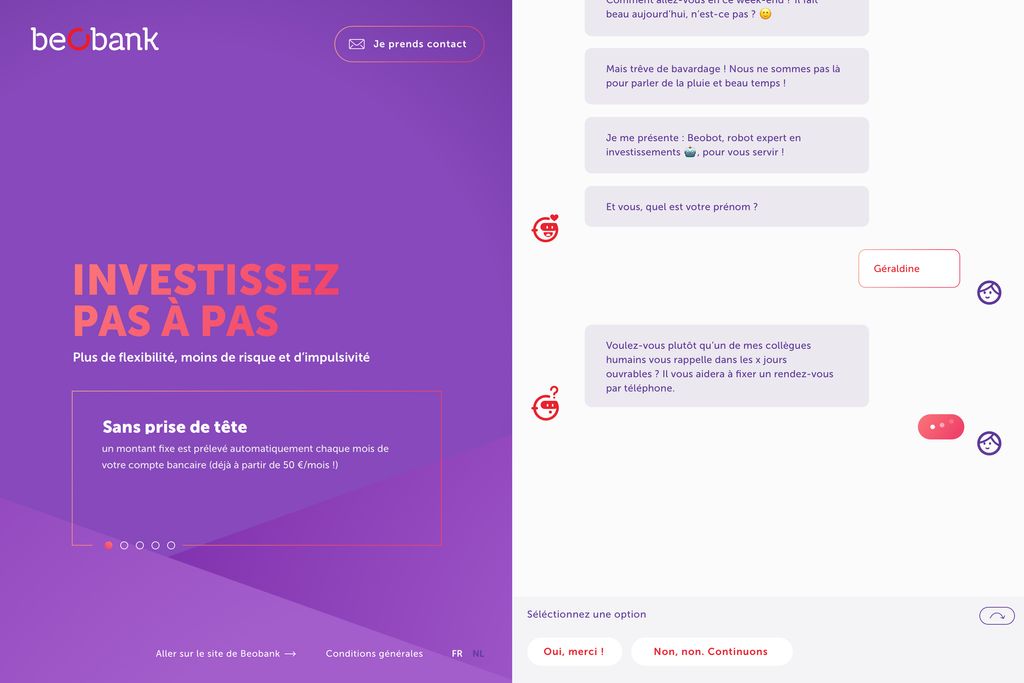
Chatbots: the early days of conversational interfaces
Long before LLMs, companies were already dreaming of chatbots.
For years, chatbots were built around decision trees: highly structured scenarios where users could only choose between predefined options.
For simple use cases such as customer support or FAQs, the model worked reasonably well. The promise was attractive: a virtual salesperson capable of answering questions, offering recommendations, and reducing pressure on support teams. In practice, however, many projects remained difficult to deploy.
- Preparing and structuring data.
- Development costs.
- Integration with existing systems.
- Inconsistent response quality.
And perhaps most importantly, these interfaces were never particularly effective for exploring a website… A website offers content, visuals, interactions, and experiences. Things a simple chat window struggles to leverage fully.
Navigation: a useful guide, but not a perfect one.
Designing intuitive navigation has always been a challenge.
Should content be organised by product? By audience? By use case?
Should you use a simple menu or a mega menu? And how do you guide visitors who land directly on an internal page, which represents nearly 60% of all website traffic?
For years, the answer has often been the same: add a search bar. The ultimate safety net for complex information architectures.
Even with excellent UX work that highlights the most relevant content, it’s difficult to imagine a website without one.
For good reason. The numbers are striking:
- 43% of visitors use the search bar directly.
- These users account for only 15–30% of total traffic.
- Yet they can generate up to 45% of e-commerce revenue (Opensend, 2024)
At Amazon, conversion rates increase from 2% to 12% when visitors use internal search.
In other words, people who search are often your most qualified visitors. And yet, more than 80% of companies neither optimise nor properly measure the performance of their internal search engine (AddSearch, 2024).
From searching to asking
This is where language models become interesting. The real strength of LLMs is that it’s transforming search itself.
With a conversational search engine, users can simply describe what they’re looking for:
- “A simple dinner recipe for a family of four.”
- “A romantic weekend near Paris.”
- “Running shoes for rainy weather.”
Rather than adding a chatbot on top of an existing interface, a far more effective approach is to merge search and conversation into a single entry point. One capable of:
- Understanding user intent.
- Exploring website content.
- Reorganising results dynamically.
- Delivering a near-tailored experience.
Search becomes a new form of navigation.
Or perhaps more accurately: we stop searching and start asking.
Walmart, Spotify, Airbnb: they’re embracing it
Several major platforms have already embraced this approach.
Walmart introduced conversational search in 2024, allowing users to describe their needs in natural language. The company reported a 22% increase in e-commerce growth during the first quarter of 2025.
Airbnb has been experimenting with a similar approach for destinations and accommodation since early 2026 (link).
Zalando deployed conversational search across 25 markets and more than two million users. Natural language queries are reportedly three times longer than traditional searches.
Spotify now lets users request things like “sad music for painting wilted flowers” and generates a custom playlist in response (link).
Let’s talk numbers
This becomes even more compelling when combined with a headless architecture. In such environments, consuming, manipulating, and dynamically reorganising content is already a native behaviour.
Open-source conversational search solutions such as Meilisearch and Typesense have reached an impressive level of maturity and can integrate relatively easily into modern composable ecosystems.
Implementation costs depend largely on the visual experience you want to create. Recurring costs can start around €30 per month and scale to €1,500 or more for larger infrastructures or advanced solutions such as Algolia or Coveo.
Not so fast, chatbots still matter
Chatbots still have a role to play. They remain highly relevant during later stages of the customer journey:
- Customer support.
- Purchase assistance.
- Product onboarding.
- Help with complex interfaces.
But during discovery and consideration phases, content remains essential. Conversational navigation offers an interesting middle ground. It preserves the richness of a website while making interaction feel more natural.
In the meantime, there are millions of search bars out there just waiting to reach their full potential.