
- Author
- Benoit

- Date
- 15.06.2026
- Reading time
- 4 min
- Categories
- Branding
- AI
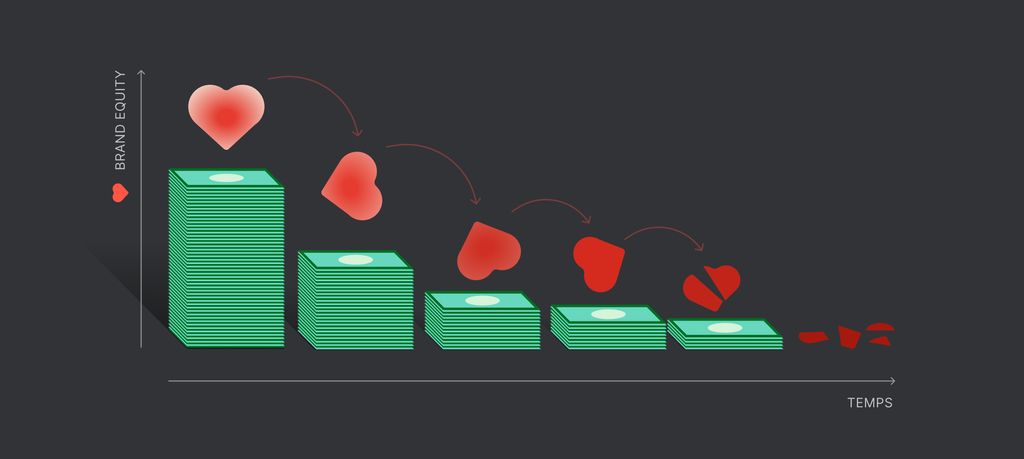
Brand Equity: The Real Risk Isn't Failure. It's Being Forgotten.
Brand Equity, the value people attribute to a brand beyond its objective features, is quietly eroding. It’s not because CMOs and Brand Managers are doing a poor job. Quite the opposite: the market is pushing them elsewhere.
I’m not going to talk about AI. Well, not yet. Because something more urgent, and less visible, is already happening. Last December, a study by Ortelius for the Belgian Advertising Council put numbers behind a feeling many marketers already had. In Belgium, advertising investment has fallen from 0.75% of GDP in 2000 to just 0.47% in 2024. In real terms, spending is now 11% lower than it was twenty-five years ago.
Behind these figures isn’t an industry that has given up. It’s a system that, year after year, pushes marketing teams to sacrifice the long term in order to survive the short term.
Caught in the middle
We see it in the briefs EPIC receives and in the budget decisions we’ve been helping clients navigate over the past few years. On one side, social platforms continue to compress organic reach. Facebook sits somewhere between 2% and 5%, and the rest are following the same trajectory. Brands are forced to spend more and more simply to remain visible, often at the expense of organic content. (Charlotte Billy explores this phenomenon in detail on Stratégies.fr).
On the other side, leadership teams keep asking marketing departments to do “more with less”. Immediate ROI. Short cycles. Measurable outcomes.
Caught in the middle, what gets cut first? The foundational projects.
Brand repositioning? Digital transformation? Customer experience optimisation? Anything that contributes to Brand Equity but can’t be measured within a few weeks tends to be postponed.
The problem is that “later” always arrives eventually.
Brand Equity, the value that’s disappearing in plain sight
Brand Equity is what people think, feel, and associate with your brand. It’s the reason someone chooses you without hesitation. The reason they’re willing to pay a little more. The reason they come back. The reason they recommend you.
It’s what makes someone feel like they’re helping change the world when they wear Patagonia. Or a little more creative when they work on a Mac. That feeling doesn’t appear overnight. It is built over time, interaction after interaction.
Research has been pointing in the same direction for years. Based on thousands of campaigns analysed, Binet & Field identified an optimal balance: 60% of marketing investment dedicated to brand building and 40% to performance activation. Market reality tells a different story. According to Gartner (2023), the average split is now closer to 40/60, heavily favouring short-term performance. That imbalance slowly chips away at Brand Equity, often without anyone noticing.
A distinctive brand identity, a strong organic content strategy, conversion optimisation, and a consistent omnichannel experience are not secondary expenses. They’re the building blocks of Brand Equity. This is where consideration, preference, and loyalty are created. Everything that happens between awareness and conversion. Everything that cannot be bought with a click.
The good news? Companies that continue investing in Brand Equity during difficult times grow 2.5 times faster than those that cut back (McKinsey).
Now let’s talk about AI…
Today, 58% of consumers already use generative AI tools instead of search engines when looking for products and services. Gartner predicts a 25% decline in traditional search volume by the end of 2026.
What does that mean for Brand Equity? It’s an existential threat. Nothing less.
First the internet, then social media, opened entirely new creative spaces for brands. For the first time, companies could move beyond advertising and build richer relationships with their audiences. They could tell stories. Create experiences. Develop emotional connections.
Large Language Models are beginning to sweep much of that away.
Unlike search engines, AI assistants don’t simply return a list of results and let users decide. They absorb information, transform it, and present it through a neutral conversational interface stripped of most of its creative packaging. No visual identity. No interactions. No videos. No carefully designed experiences. Just answers.
And there’s something even more significant happening. Conversational interfaces don’t merely process information, they interpret it, prioritise it and in a sense, they judge it.
In this new landscape, strengthening Brand Equity becomes a matter of survival. If LLMs become the next major layer of influence, the goal is no longer simply to appear among several options when someone asks: “I’m looking for custom-made furniture. Can you help me?”… The real objective is to make sure the user asks: “I’ve heard Camber is recommended for custom furniture. Is it truly bespoke?”.
The difference between those two questions? Brand Equity. The emotional connection you’ve built in people’s minds long before they open an AI assistant.
So what do we do?
The answer isn’t to change everything overnight. It’s to gradually rebalance a few priorities.
- Protect your Brand Equity. Even a modest investment in brand building and long-form content generates cumulative returns that paid media alone cannot replicate.
- Prioritise quality over volume. One strong piece of content designed for a specific audience will outperform a dozen generic posts. That becomes even more important as AI floods the web with interchangeable content.
- Improve every touchpoint. Your website, your purchase journey, your customer service, your visual consistency. This is where Brand Equity is built, or destroyed.
- Prepare for AI-driven discovery. Influence creates influence. Brands that invest in organic visibility, expertise, and authority today are more likely to be recommended by AI systems tomorrow.
None of these actions require astronomical budgets. What they require is conviction. The belief that brand value is built over time, not during the next sprint.
The real question isn’t: “Can we afford to invest in our brand?”. It’s: “Can we afford to wait?”.