
- Author
- Jérémy Bachelet

- Date
- 15.07.2026
- Reading time
- 4 min
- Categories
- Branding
Down a very slippery trope
Unbearable to read?
Tell me your eyes bled at least a tiny bit reading the post above! Tell me I’m not the only one losing my mind at the state of my feeds and of articles online… The fake triads, the “here’s where it gets interesting”, the em dashes, the overall rhythm of the structure… I can’t take being drowned in this literary gruel any longer.
And you know why it’s so unbearable to read? Because it’s digital hot air. Because the tsunami of content generated in the laziest way imaginable has become a standard our poor brains are subjected to on a daily basis.
Granted… it took me ten times longer to write this little paragraph than it took to generate the bullshit post above. And this paragraph alone will probably tank the GEO score of the entire page.
But for pity’s sake, could we show a little more respect for the brands we represent (and for ourselves, some of us being our own brand), and put in EVEN THE BARE MINIMUM of effort to tell our audiences something meaningful, something that respects their DNA and personality?
AI tropes
So what makes every post look like it was laid by the same hollow brain? These turns of phrase, used to death by every current generative AI model, have a name: AI tropes(“dun dun duuuun”).
Tropes are defined as recurring narrative devices. The ones I’m interested in here, AI tropes, are simply used by LLMs as an editorial roadmap to simulate the linguistic expertise of a content creator.
Why do they exist? The reason is fairly simple: because of us. Generative AIs, fed on billions of literary sources, have simply standardized an “average” mix of grammatical, lexical and semantic constructions meant to perfectly imitate the best content creators.
Which is obviously very clever… in theory.
Practically, it’s as if:
- Every LinkedIn post opened with a one-line shock statement. Then a blank line. Then a vulnerable confession, but not too vulnerable. Ah, we were already doing that.
- Every piece of thought leadership had to feature a failure turned into a life lesson (“I was told no 47 times. Here’s what it taught me”). Ah, we were doing that too.
- As if we publicly congratulated total strangers on their “thought-provoking post” without ever making it past line three. Ah… right, ok.
See where I’m going with this? Turns out we never needed AI to standardize our content and blitz ourselves with tropes… AI tropes are basically our 2019 feeds, compressed, averaged out, and served back to us on an all-you-can-eat basis.
They’ve even been catalogued, for better and for worse, and once your eyes are open… you see them EV-ERY-WHERE. I refer you to the excellent Sloppy Pasta website, which will both give you a great time and make you deep dive into the analysis of this sad phenomenon.
Shall we dissect?
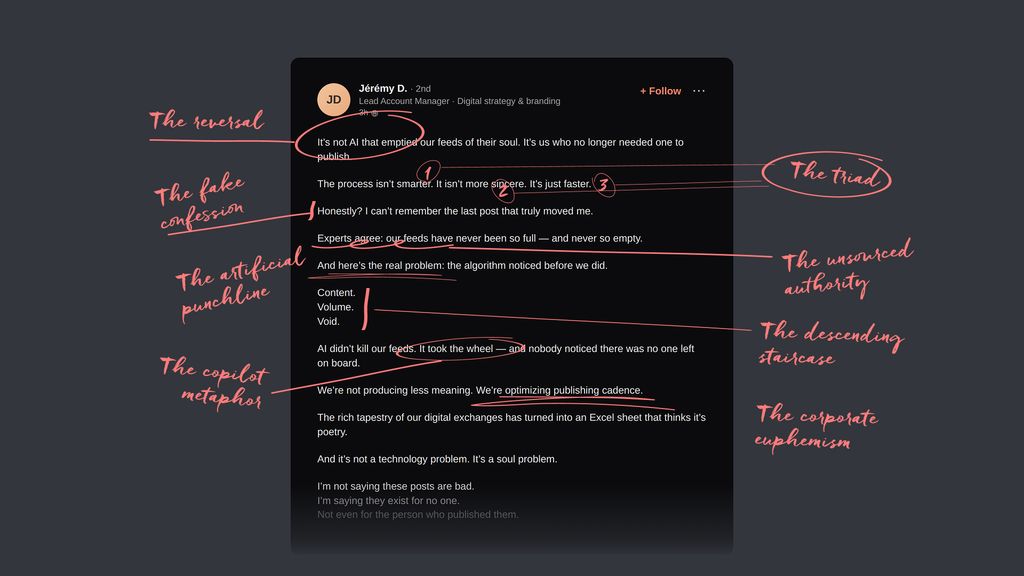
Let’s push the exercise all the way! That fake, unbearable LinkedIn post at the top of this article? It was generated from a single source sentence, by forcing an LLM to rewrite that sentence through the lens of the AI tropes most used by LLMs (Cyrano de Bergerac style, you get the reference?). The craziest part? It almost formed one continuous text…
The isolated rhetorical question
Are our feeds even alive anymore?
The reversal
It’s not AI that emptied our feeds of their soul. It’s us who no longer needed one to publish.
The triad
Not smarter. Not more sincere. Just faster.
The fake confession
Honestly? I can’t remember the last post that truly moved me.
The unsourced authority
Experts agree: our feeds have never been so full — and never so empty.
The artificial punchline (“here’s the real problem”)
And here’s the real problem: the algorithm noticed before we did.
The descending staircase
Content. Volume. Void.
The copilot metaphor
AI didn’t kill our feeds. It took the wheel — and nobody noticed there was no one left on board.
The corporate euphemism
We’re not producing less meaning. We’re optimizing publishing cadence.
The exhausted extended metaphor
The rich tapestry of our digital exchanges has turned into an Excel sheet that thinks it’s poetry.
The falsely resolved dilemma
It’s not a technology problem. It’s a soul problem.
The cascading pathos
I’m not saying these posts are bad. I’m saying they exist for no one. Not even for the person who published them.
The real victim
So here I am, ranting and stamping my feet… but maybe I just have a little too much free time on my hands, spending it analyzing all this? And don’t we all kind of not care, deep down? Well… no. Because the main victim in all this isn’t (just) me, it’s your brand (your “brand equity“, as we love to say in agencies).
Generating an article on any current model with a prompt as ambitious as “Act as a digital content creator and write an article about using artificial intelligence to generate content” will guarantee you three things:
- Content whose depth rivals the footbath of your local municipal pool;
- Driving anyone actually looking for interesting content completely insane;
- Damaging your brand image a little more with every generated sentence.
So let’s take a deep breath, roll up our sleeves like the brave big girls & boys we are, and take a little time to use AI to strengthen our brand equity, not to flood our ecosystems with flavorless, valueless content.
Come on, repeat after me: “My brand deserves better than this. And so do I.”
There, I’m done!
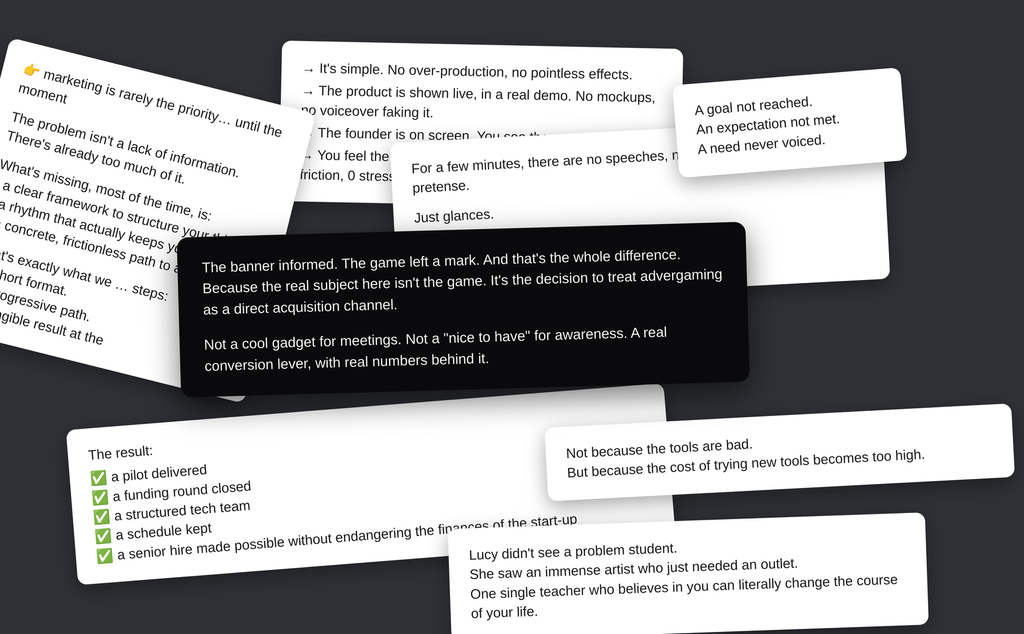
To thank you for reading all the way through, here’s a little gallery of choice examples (anonymized, but all real, unfortunately)… And the one at the top is mine (Killmeplease).
PS: If after reading all this you’re wondering “Ok, but concretely, is it even possible to use an LLM to generate content while respecting my brand?”, the answer is YES, and we’d be delighted to show you how.