
Games, flames, and pigeons.
The words ‘Smoking kills’, written in capital letters beneath a photo of a necrotic lung, have never made anyone put out a cigarette… The “Eat five portions of fruit and vegetables a day” signs only spark sarcasm in the McDrive line. And you can still read “Slow down to see what’s coming” while cruising at 87 mph in a driveway.
Rational arguments, scientific evidence, and the sorrowful eyes of the English cocker spaniel mourning its owner have ceased to have any effect on people’s consciences.
So we, communicators and marketeers, cooked up another way of nudging people toward better habits (= Pulling them back onto our platforms). We’ve stopped trying to persuade them and decided to entertain them instead ! We gamified their world.
Let’s take a look at that.
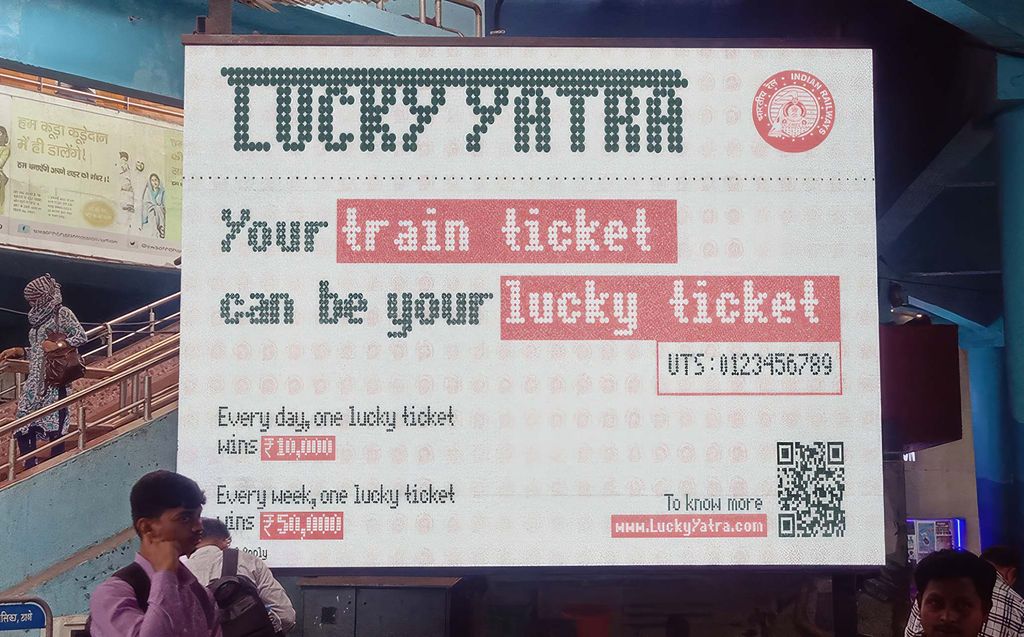
Lucky Yatra turns every train ticket into a lottery ticket.
In India, the railways bleed cash every year because of tricky fare evaders. Checks and fines? Nada. Yet the same folks who can’t spare a rupee for a ticket will burn through wads of cash on lottery lines. The dors were quickly connected in smart marketeers’s minds and boom: Lucky Yatra. Your train ticket is now a lottery ticket.
In Stockholm, a speed camera photographs every car, even the ones obeying the limit. Offenders’ fines feed a fund that rewards law-abiding drivers. Slow down and you could win. Result: average speed dropped overnight.
In Hungary, grooves carved into the tarmac make tires play a melody at the speed limit. Drive too fast and the tune falls apart. Calm driving now sounds like Guitar Hero.
Nobody travels for the right reason
Passengers don’t buy tickets to plug the Indian Railways deficit the same ay that most drivers don’t ease off the accelerator to cut road death.
Gamification doesn’t recruit saints. It plants a parallel, personal goal. The collective win is “only” a side effect of individual fun.
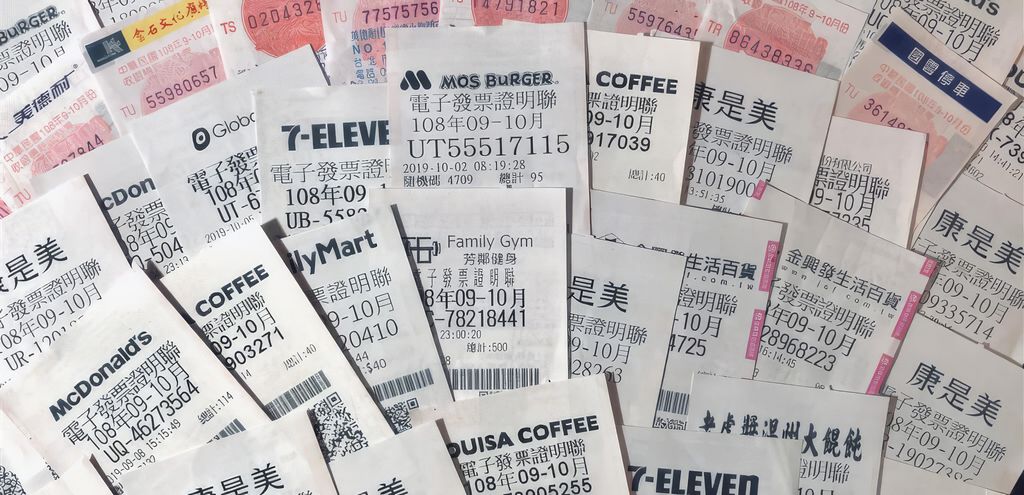
Taiwan has run with this idea since 1951 to counter tax fraud among shopkeepers. Each store-purchase receipt carries a number entered into a prize-draw every two months.
The result ? Customers now demand their receipt because they might win, and shopkeepers can no longer take payment without declaring it. The country now has six million volunteer tax inspectors, and none of them wake up thinking about the national budget.
I’m not endorsing the gimmick. I’m simply saying that while the term ‘gamification’ probably didn’t exist more than 75 years ago, the mechanics behind it were already well understood.
It starts with the desire to win
These examples share the same driving force: the prospect of a reward or pleasure that remains uncertain.
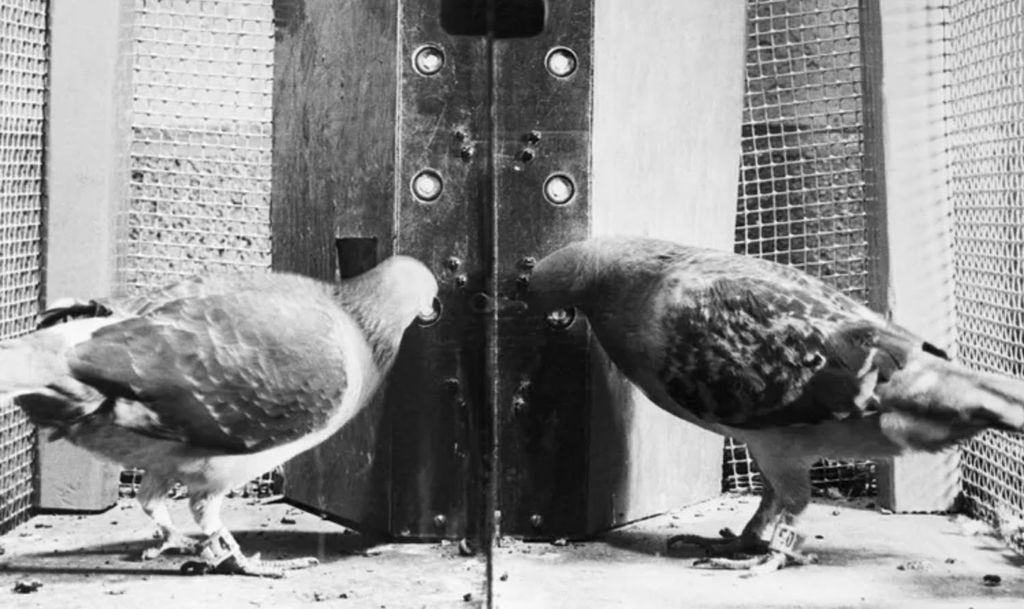
In the 1930s, Skinner placed rats and pigeons in front of a lever. When each press of the lever delivered a small amount of food, the behavior became established without excess. But when the reward became unpredictable, sometimes nothing and sometimes a lot, the behavior became compulsive. The animal keeps pumping the lever long after hunger was gone.
That’s how you unfailingly create addiction. The pigeon doesn’t return to eat but to discover its reward of the moment. Just as we swipe down on our screens to refresh notifications every five minutes.
(Yes…the conclusion is that we are pigeons too, in a way.)
It all boils down to the fear of losing
Digital tech has hatched another hook: the fear of losing.
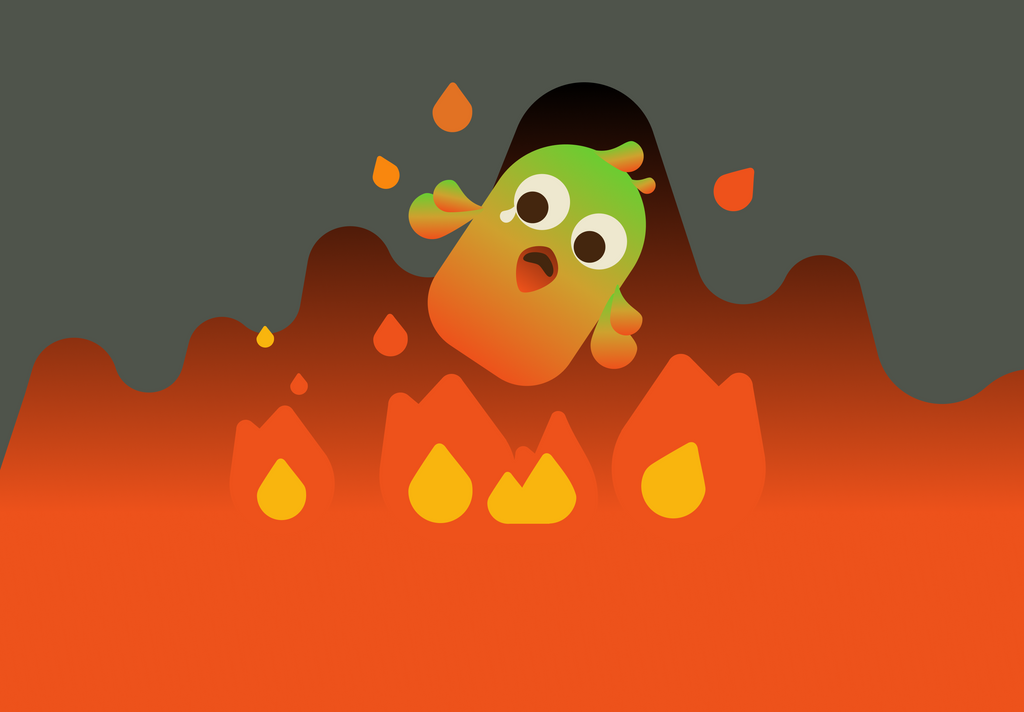
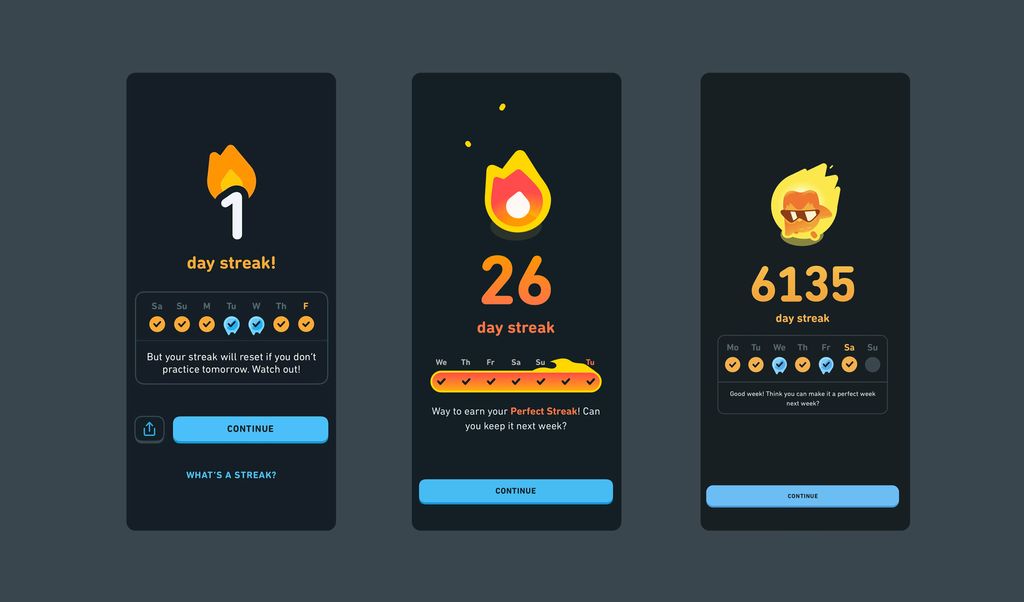
Losing hurts more than winning feels good. Duolingo streaks, Snapchat flames, and TikTok series ride this truth.
A user who has built up a streak of three hundred days now possesses virtual capital that they could lose, and that engages them far more than the prospect of a future reward.
As the streak lengthens, desire morphs into obligation, then into identity. This is “retention gold”, because quitting hurts bad.
The consequences
Then come the side effects. The Snapchat flame assigns a score to a friendship, and some teenagers swap their login details before going on holiday to make sure they can keep the streak going. The fear of losing it is so strong that they’re willing to hand over their login details.
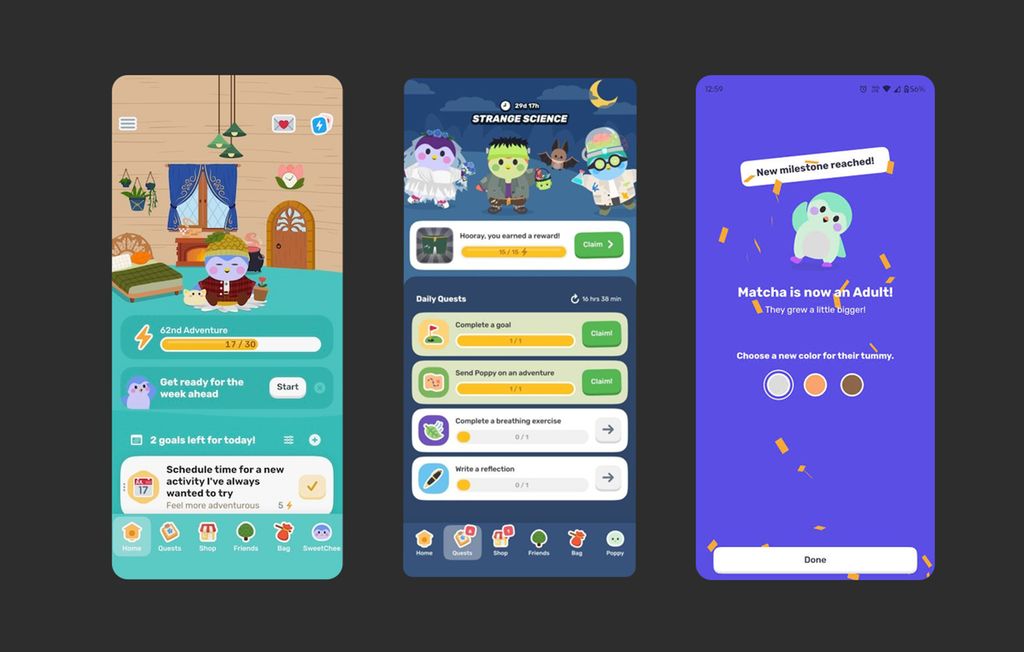
Finch is a wellbeing and productivity app where you raise a little bird by completing breathing exercises and mood assessments. It works on the basis of an unpredictable daily reward and six character traits that the bird develops beyond the user’s control. The user can therefore never predict what the bird is becoming. Well, well, yet another bird, and there are plenty more where that came from (cough DuoLingo cough).
Ironic to use uncertainty as a hook in a productivity app, isn’t it?
The scoreboard isn’t the match
The three mechanics developers bring in first in a game (badges, leaderboards, points) are also the ones users drop fastest.
LinkedIn pulled its Top Voice badges in 2024. Award winners cranked out more posts, but quality tanked. They were writing just to get the badge.
Foursquare axed its “Mayor” titles a decade earlier for the same reason: the feature drove tons of check-ins but killed the exploratory behavior the model needed.
Yu-kai Chou (one of gamifiction’s pioneers) sums it up: the scoreboard isn’t the game. No fan walks into a stadium, glances at the score, and suddenly feels the urge to play baseball. A leaderboard flatters a tiny slice of players but leaves the rest in the stands.
Strava took a different approach. Instead of one big leaderboard, the platform spins up millions of tiny ones. Each segment is a stretch of road a user maps (the hill on their daily commute or the straight shot in front of their workplace) and the runner is compared with people of the same age, category, and neighborhood.
Turns out winning the Division 4 championship feels better than just hanging in Division 1. What keeps people coming back is the chance to win. The trick is to shape the game so everyone has a shot.
Progression mechanics
Gamification is often reduced to points, badges and leaderboards. The range is actually much broader: status tiers, quizzes, referral schemes, challenges, scratch cards and progress bars.
The progress bar…
It deserves a special mention, as it taps into the need for completion. It’s the cheapest mechanism on the list and the most universally effective. You’ll find it on all multi-step forms; it reassures us and says, “Don’t worry! You’re almost done!”
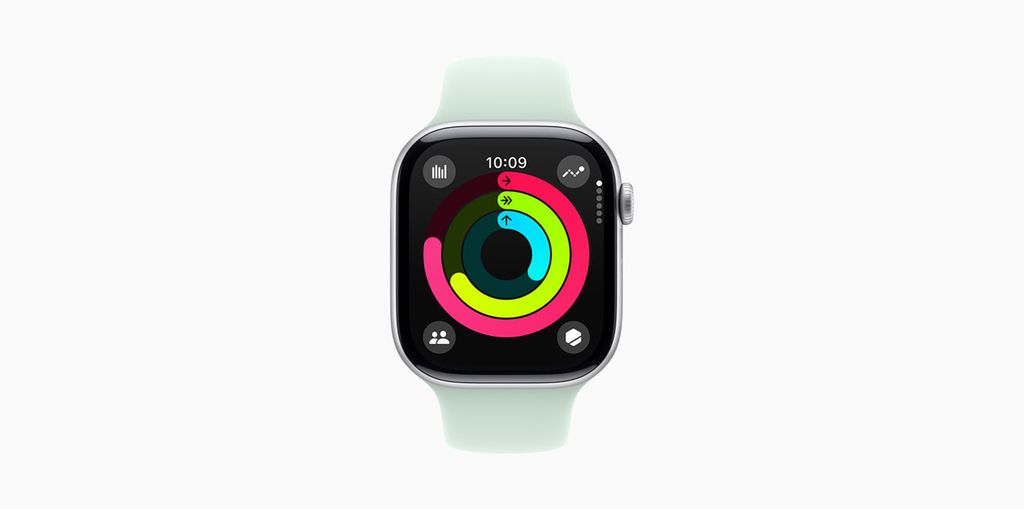
Apple takes a different approach: the Apple Watch rings. They’re beautiful and round, gentle and colorful. And they work without threatening your hard-earned social status.
Three rings to complete each day, with no streak to protect and no counter that resets to zero. A ring that’s 80 percent full makes you all the more eager to finish it, because the brain has a hard time dealing with unfinished shapes. In design psychology, it’s called closure. The user who pauses loses nothing, yet feels a powerful urge to finish.
The second piece is skill. Gamification can fake autonomy and belonging, but the sense of real progress is the only feeling that sticks and the most honest we can give. A ‘100 sessions’ badge only matters if 100 sessions actually happened. Chess.com tracks both Elo rating and platform activity. That distinction makes all the difference.
So, should I gamify my app?
Nobody wants to treat users like fools, so ask these five questions before you pick the mechanics.
Does the mechanic ultimately measure a real skill?
A counter for app opens is a useful but incomplete indicator. Use it as an incentive, but it’s not enough on its own.
How many mechanics?
Beyond a certain point, every extra bell or whistle drains engagement instead of lifting it. Habitica, the most fully gamified productivity app on the market, buried the actual work under its own layer of gameplay. Stick to 1 goal, 2 to 3 mechanics at most, and above all, 1 to 2 progress indicators.
Can the user pause without penalties?
If not, you’re building anxiety, and regulators are already knocking at your door.
Who suffers the effects?
The ‘musical motorway’ we talked about earlier was dismantled at the request of local residents, who could hear the anthem for much of the night. A mechanism always has an impact on people who have not chosen to take part in it. When your kids butt in to keep the flame alive, it’s a distraction for them and the whole family.
Does the context allow for it?
When it comes to health, debt, bereavement, or addiction, is the mechanism sensible or completely inappropriate?
And when the user finally wins, does the system still beg them to stay?
Duolingo wants you to speak Spanish. Snapchat wants you to open the app. The mechanics are similar, but the intentions are not, and it is the intention that separates brilliant design from insidious manipulation.