


- Author
- Benoît Rondeux
- Date
- 05.11.2026
- Reading time
- 6 min
- Categories
- Trends
Your marketing budget is shrinking by the wash!
Fall is already here…which meaaaaans… BUDGET SEASON (Yaaay!). And boy oh boy, will this one be (yet) tougher than the previous ones: a sluggish economy, an increasingly complex and competitive digital ecosystem, and an AI transformation that’s still too slow to hit teams’ day-to-day work.
The bad news is this mess will drag on. The good news? You still have time to pivot.
And above all, don’t follow your first instinct…don’t go and slash into your marketing budgets yet again!
Back in April, we discussed how brand value erodes silently when management demands that teams ‘do more with less’. If you need to defend your marketing budget in the coming weeks, here are some key figures to feed the discussion, taken from the Ortelius 2025 report (commissioned by the Advertising Council, the federation of the Belgian advertising sector) and the 2026 forecasts.
Frozen budgets shrink
Globally, ad spend keeps climbing. WPP Media, the world’s biggest media buying group, just bumped its 2026 forecast to +8.9 percent, up from +8.8 percent in 2025.
In Belgium, though, the story flips. The latest UMA benchmark shows a flat market: -0.2 percent in H1 2025, per the freshest numbers. Of the €1 billion flowing into digital each year, only 38 percent stays in Belgium; the rest goes to search and social, mostly to Google and Meta (Ortelius, 2025).
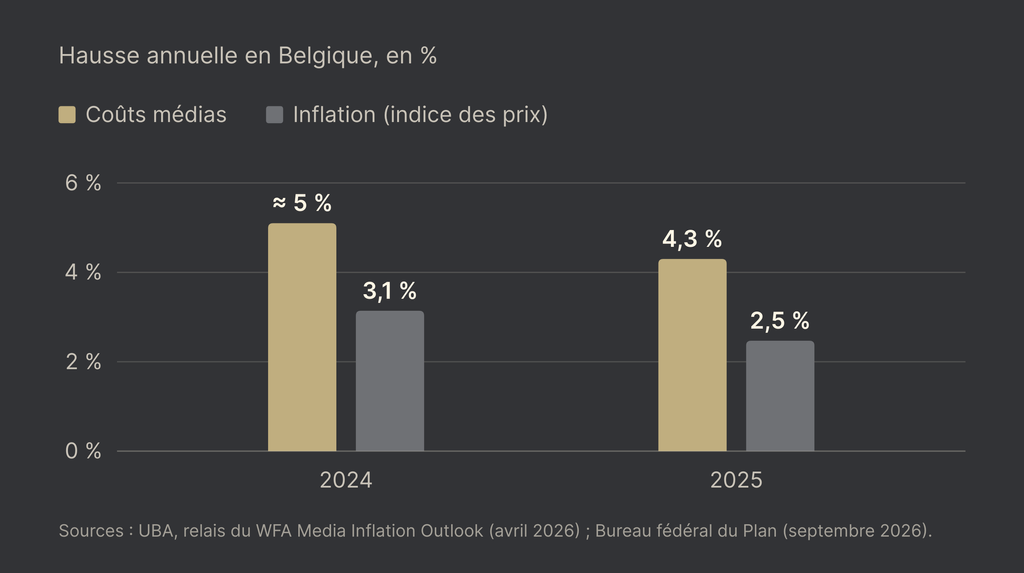
Meanwhile, media costs keep climbing: +4.3 percent in 2025 after a roughly 5 percent jump in 2024, per the UBA (Union of Advertisers). That’s 1.7 times general inflation, so even a budget tied to the CPI is slipping. A flat budget buys 4–5 percent less visibility every twelve months. On a €500,000 media budget, that’s €20,000 to €25,000 of visibility vanishing every year without a single line changing in your budget spreadsheet.
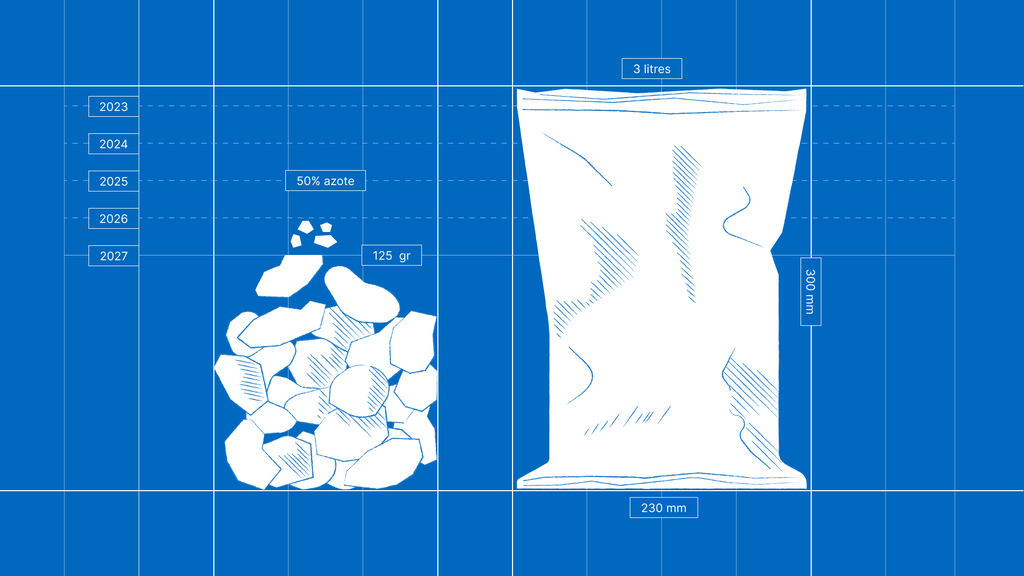
It’s the same trick as shrinkflation in the snack aisle: the bag of potato chips keeps its size and price, but a portion of the chips vanishes.
And even then, this stagnant market is a national average. In traditional media, the French-speaking ad market captured 36 percent of investment in 2024 for 43 percent of the population and grew four times more slowly than the Dutch-speaking market (media agency Space, based on Nielsen figures).
In French-speaking Belgium, including Wallonia, we start from a lower base.
CPA is a bit of a short-sighted view!
Costs rise faster than budgets, so the top-down directive is always the same: shift spend to whatever converts right now, squeeze CPA quarter after quarter, and park anything that doesn’t pay back within twelve months.
CPA is a solid gauge of immediate campaign results. The trouble starts when it becomes the one and only metric on the dashboard, because it misses most of what marketing does.
Binet, co-author with Peter Field of *The Long and the Short of It*, the IPA study, reiterated this at the end of August during the UBA Media Date, the annual event for Belgian advertisers: Over-optimize, target too narrowly, sacrifice creativity, and you eat into profits. When one campaign underperforms another, the gap usually boils down to budget: IPA case studies show it explains 89 percent of the variation, leaving targeting and optimization in the dust. When rivals pull back, the brand that holds its budget grabs share of voice: sit ten points above your market share and you pick up about half a point per year. Sounds logical, right? And yet… #nocomment.
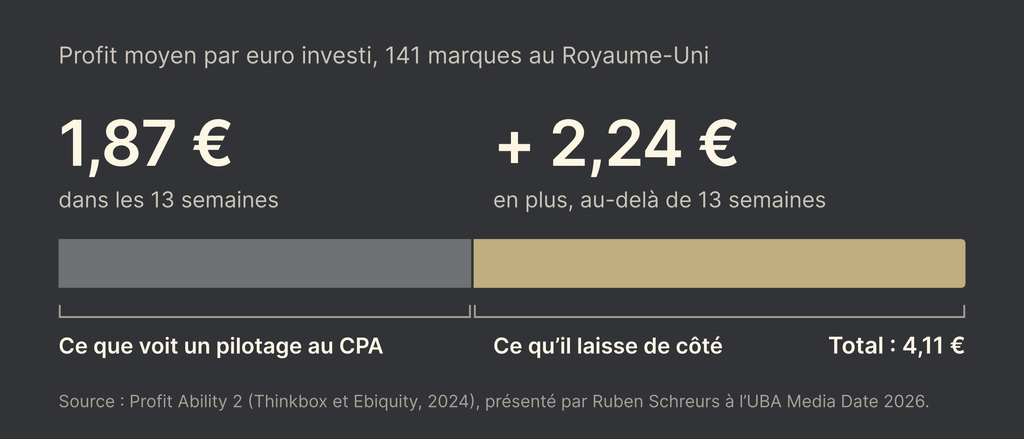
On the same day, Ruben Schreurs from media audit firm Ebiquity showed what short-term metrics miss, citing the British Profit Ability 2 study (Thinkbox and Ebiquity, 141 brands): One euro invested in media yields an average profit of €1.87 within three months, and €4.11 once long-term effects are factored in. Managing campaigns based solely on CPA therefore overlooks more than half of what the budget actually yields.
BYD, the Chinese car maker, learned this in Belgium. In 2023, fresh in the market, it ran all digital, all the time. Customer acquisition costs climbed. Sales stalled. In 2024 the brand added TV, outdoor, and Euro 2024 sponsorship to the mix. Within a year its CPA fell 71 percent on social and 64 percent on search while sales jumped nearly fivefold (editor’s note: versus the modest 2023 figures from its market entry).
A fluke of the EV market? Nope.
Lessons from the 2025 Effie Awards
Two other entries in the 2025 Effie Belgium awards, which recognize campaigns based on their measured commercial results and in which BYD was a finalist, speak directly to the issue of budget constraints.
Mobile Vikings refused to join a price war and poured money into video and content instead. Result: a 67 percent customer jump and €28 in revenue for every euro spent on media.
Quick faced McDonald’s on a fixed media budget. Instead of business as usual, the brand launched a bold creative concept, a waffle burger called Le Belicatesse, with a guerrilla teaser followed by a national push that earned nearly a million euros in free media. Result? Sales up 12 percent, campaign recall beating the market leader even with 31 percent less visibility.
Of course, the brands and their agencies wrote these case studies themsleves, so read them with the necessary critical eye. Still, the arrow points in one direction. When the budget can no longer keep up with media costs, it is the brand and the quality of the creative work that make up the difference. These are therefore the two areas that must be protected first in budget discussions, and yet they are the ones that get cut when major projects are postponed.
AI: cheaper or better?
AI keeps popping up in every budget meeting and most teams first see it as a way to trim the marketing budget.
For routine tasks, it works: at EPIC, certain tasks have taken 50 to 60 percent less time thanks to AI. But when you hit a brand platform, art direction, or complex custom-made development, the savings shrink. Insist on the same discount and you get the same-looking work with less thought inside. The “potato chips bag” effect strikes again.
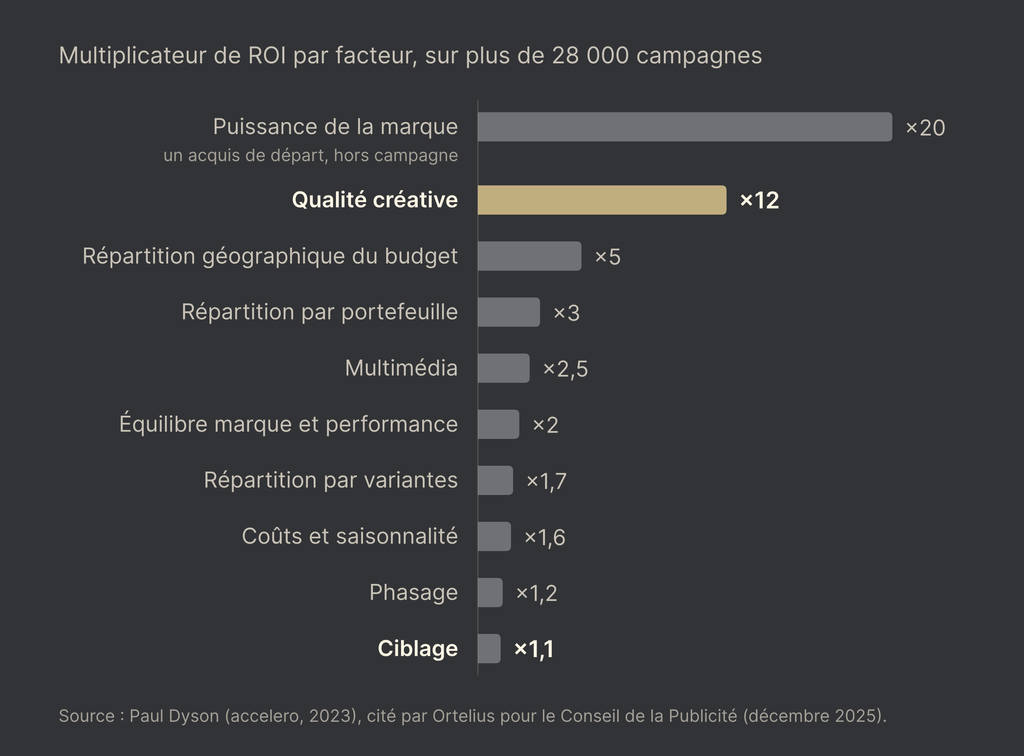
Instead, ask yourself where to reinvest the time you save. According to the UBA’s 2026 collaboration cycle, advertisers rank strategy and customer insight first. On the creative side, the figures from Paul Dyson, the British econometrician who analyzed the profitability of over 28,000 campaigns, speak for themselves. Creative quality can boost a campaign’s profit by a factor of 12, while targeting tops out at 1.1. So put that AI-saved production time back into creativity.
The weak link
Let’s return to the budget discussion. When things get tight, the marketing budget is the easiest fuse to blow: it costs nothing at the time, and the bill only arrives a few quarters later, in the form of lost market share and brand reputation that needs rebuilding.
On a national scale, the Ortelius study quantifies the return on this collective investment: €15.1 billion in GDP per year, or 2.53 percent, and €7.75 in GDP for every euro invested in advertising.
So if your 2027 budget leaves the room at the same level as 2026, it’s already shrinking.
Three points to put on the table before signing:
- Index the media budget to media cost inflation (4 to 5 percent per year) and benchmark it against your own CPM trend;
- A dashboard that tracks share of voice versus market share and the 12-month impact, because CPA alone captures only €1.87 of the €4.11 each euro generates;
- If indexation falls through, carve out a protected line for branding and creative at your 2026 levels. That’s how Quick, Mobile Vikings, and BYD grew.
Taking care of your brand and staying proactive in your campaigns isn’t a luxury you splurge on when times are good, like buying a new jacket with your end-of-year bonus. It keeps your share alive in lean years and lets you outrun the cutters when the sun returns.
Sources
- WPP Media, This Year Next Year, global mid-year forecasts for 2026
- UMA media investment benchmark, first half of 2025 (October 2025)
- Ortelius for the Advertising Council, The Impact of Advertising on the Belgian Economy (December 2025)
- UBA, “Media Cost Inflation Slows in Belgium,” based on the WFA Media Inflation Outlook (April 2026)
- Federal Planning Bureau, Consumer Price Index and inflation forecasts
- Space, Value of Advertising in Offline Media 2024, based on Nielsen data (February 2025)
- UBA, The Binets on the cost of a narrow-minded approach, UBA Media, August 25, 2026
- WFA, The Binets at the WFA Media Forum (June 2026)
- The Binets and Peter Field, *The Long and the Short of It* (IPA)
- The Media Leader BE, UBA Media Date 2026: three perspectives on marketing effectiveness, presentation by Ruben Schreurs, Ebiquity (August 2026)
- Thinkbox and Ebiquity, Profit Ability 2: the new business case for advertising (2024)
- Effie Belgium 2025 case studies: BYD, Mobile Vikings, Quick
- UBA series “Collaboration between brands and agencies in the age of AI,” episode 1 (April 2026) and episode 2 (June 2026)
- Paul Dyson (accelero, 2023), quoted in the Ortelius study above
What's next
Games, flames, and pigeons.
Gamify your apps whilst respecting your users.
Cuteness takes over our screens
And it’s partly Japan’s fault!
When brands get their faces back
The great comeback of brand mascots